

Lessons from Minnesota

Over the past few weeks, I have been reflecting on Minnesotans’ courageous fight against the brutal, massive ICE and CBP deployment in their state. Although the Minnesota story has receded from the headlines, the impact of the organizing and civil society’s resistance in that state has been nothing short of amazing: the withdrawal of the vast majority of ICE and border patrol agents from Minnesota; the stiffening of Democratic opposition to fund DHS without significant accountability reforms; the ouster of DHS Secretary Kristi Noem; and, importantly, the shifting of the electoral terrain against MAGA and Republicans all over the country. Minnesotans drew a red line against a shocking authoritarian assault on their state, and they forced the administration to back down.
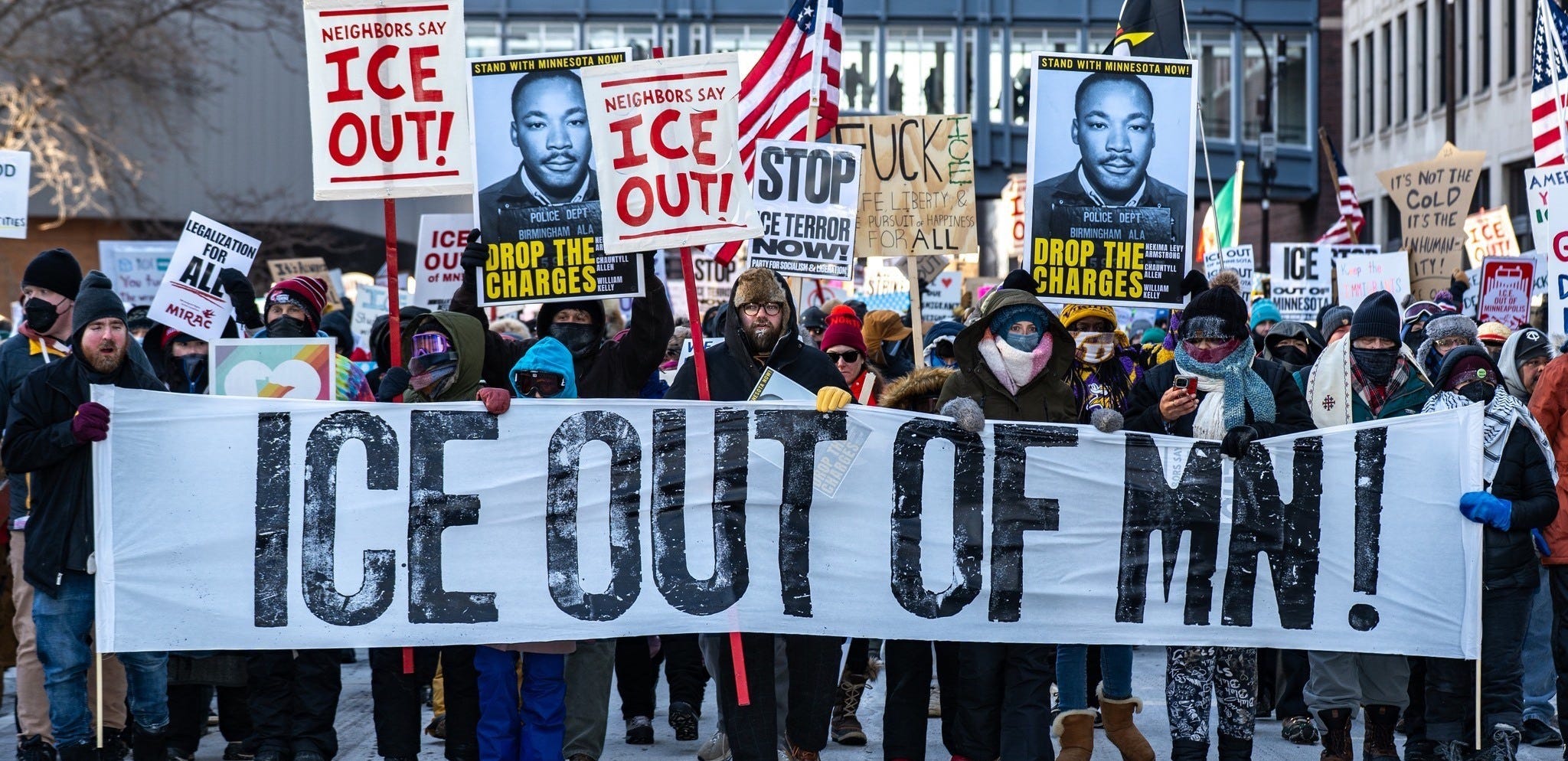
There has already been much analysis of the anti-ICE response in Minnesota. Many have pointed to the important role that organizing groups like Faith in Minnesota and Unidos MN played in training tens of thousands of people, providing structure to the resistance, and channeling mass participation into strategic action. I completely agree with those who have argued how essential the culture of organizing in Minnesota was to the success of the resistance in the state. Rather than repeat these analyses, I have a few thoughts that build on them and that I hope will add to our understanding of the lessons from Minnesota.
1. Powerful organizing in the states can fundamentally reshape the national political terrain. The story of Minnesotans’ resistance to ICE is an important reminder that our political fortunes aren’t only determined only by what happens in Washington, D.C., the quality of candidates, or how much money is available for electoral campaigns. These things matter of course, especially in tight elections. But the larger political narrative—the issues that people care about and how they view them—arguably matters more. With their courage, tens of thousands of everyday Minnesotans have reshaped the national narrative, and they did so without running a single TV ad, or fielding a poll to determine the best message, or conducting a randomized controlled trial to “scientifically” determine the most efficient mobilizing tactics. By betting on organizing and leadership development over years, Minnesota-based organizations provided the scaffolding for this mobilization moment. They protected their neighbors, deployed ICE observers in every neighborhood, and shaped the story in every gut-wrenching, awful viral moment emerging from the occupation.
The scale of the mobilization—which far outstripped what organizations and unions could have produced on their own, if truth be told—commanded the attention of the public because it was the public. The massive civic response exposed brutal, naked authoritarianism and the dishonest “shoot first, lie second, blame-the-victim third” playbook the administration used. Minnesotans put the administration on its heels on no less than its signature issue of immigration and seriously damaged MAGA’s political standing as we head into election season, not just in Minnesota but everywhere.
2. Politics as culture. We often hear the refrain that “politics is downstream from culture.” While this idea captures an important insight, it is also too neat and reductive. The reality is that political and cultural forces act on each other. In fact, if we’ve seen anything in recent years, it is the power that politics has to shape our larger culture. Consider Donald Trump and MAGA, for example. With his focus on controlling cultural and media institutions, from the takeover and renaming of the Kennedy Center to intervention in media ownership fights, Trump is using raw political power to attempt to alter the cultural content that we consume. It’s also impossible to disentangle the administration’s attacks on Ivy League institutions from its strategy of projecting an anti-elite narrative, which resonates with Americans who resent wealthy, out-of-touch ivory tower intellectuals while they are punching a clock or working gig jobs (or both) to make ends meet.
In Minnesota, political action tapped into and amplified a different set of cultural values and narratives. The viral moments from Minnesota we all saw—the videos of the murders of Reneé Good and Alex Pretti, little Liam in his blue bunny hat and Spiderman backpack, and the 75,000-person march in subzero temperatures—shook the country’s conscience about the Trump administration’s policies and its disregard for fellow Americans and immigrant families and children. When these images and videos rocketed around social media feeds, they carried an unmistakable and ominous story: any one of us could be next. But the images also broadcast the extraordinary solidarity and courage of the people in Minnesota. Ordinary day-to-day life in Minnesota was reorganized around solidarity and “being a neighbor” to someone in desperate need. People who in December couldn’t envision taking risks were following ICE vehicles as “constitutional observers.” Others stepped in to drive children to school not just on one day of the week, but every day. The political actions of tens of thousands of ordinary people in Minnesota had deep cultural resonance because they reflected values we hold dear and aspire to: bravery in defense of innocent people, courage when needed to confront injustice, and looking out for our neighbors and those less fortunate.
These American values provided the cultural currency that grabbed and focused our attention in a way few other moments have done or sustained.
3. Corporate elites are cowed or accomplices. Or, more likely, both. Experts on authoritarianism say that rolling back autocracy requires that pro-democracy forces drive wedges between the regime and elite actors and institutions. The scale of civil resistance in Minnesota was astounding. By some estimates, a full quarter of the state’s population participated in the general strike at the end of January—making it the largest mass economic action in the United States in several decades. And yet, while organizers directed power and pressure on major Minnesota corporations, demanding that Target, 3M, and US Bank cease cooperating with and speak out against the administration’s immigration enforcement policies, these corporations refused to make a clean break with the administration. For all intents and purposes, they remained silent.
Their refusal to budge despite the scale and scope of civil resistance underscores a key challenge we face. The fear the titans of business have toward Trump and MAGA is tremendous and difficult to overcome—or perhaps they benefit from the status quo too greatly to listen to their employees or their consciences. And yet we must somehow induce or force corporate leaders and elites to let go of their cowardice and capitulation—or their avarice—and take a stand with the people and for American democracy.
Corporate inaction in the face of the authoritarian blitzkrieg in Minnesota surfaces a deeper vulnerability hard-wired into our political system: the all-but unfettered ability of corporations and billionaires to deploy their vast wealth and resources to buy influence with our elected officials. Trump has gone further than any politician in recent memory to manipulate our system to both enrich himself and forge a corrupt and compliant corporate class. The range of legal and extralegal vehicles Trump and MAGA have set up to amass millions in tribute is astounding. There are the “normal” ways for the wealthy and corporations to offer contributions, such as through Trump’s inauguration fund, presidential library, independent expenditure committees, and so forth. And then there are extraordinary vehicles like investments in Trump’s crypto currency and Truth Social, donations to the East Wing demolition and renovation, and opportunities to finance his development projects all over the world. And Trump’s operation knows how to keep score. In our system, corporations and billionaires can buy off politicians; and Trump has laid bare the corollary principle that an autocratic politician can shake down corporations and billionaires.
Let me preface this next point by acknowledging that I’m an optimist. In the near future, when we reach the stage in this country where we are reimagining the structures and rules of our democracy, it’s clearer to me than ever that we need a serious national conversation about breaking the economic and political power of corporate elites. Despite flag-waving ads or gauzy statements on the Fourth of July, we should never forget that the American corporations and their CEOs that so dominate our economy and politics aren’t intrinsically for democracy—they are for their own bottom line. They have accrued a massive share of our national income and wealth and removed nearly all constraints on their ability to deploy their outsized resources to influence our political process. They seem to have little compunction about getting into bed with a dictator when it serves their financial interests. And it will be hard to get them out of that bed even when the times call for it. Even when their home cities are invaded. But reining in their influence is essential, perhaps existential, and we must think big and with urgency about the strategies, and build the power, to do so.
What’s encouraging to me is that organizers all over the country are both inspired by and learning from Minnesota’s success—both as a call to deepen their organizing practices now and as a guide for what to do if ICE shows up in their communities or at polling places. There are vastly more strategists, organizers, funders, and others who are awake now to the authoritarian threats and the responsibility to meet it than before January. Vastly more. Minnesotans threw ICE out, largely, at great cost personally, financially, and emotionally but they have hardened the resolve of patriotic, pro-democracy Americans in every corner of the country.